


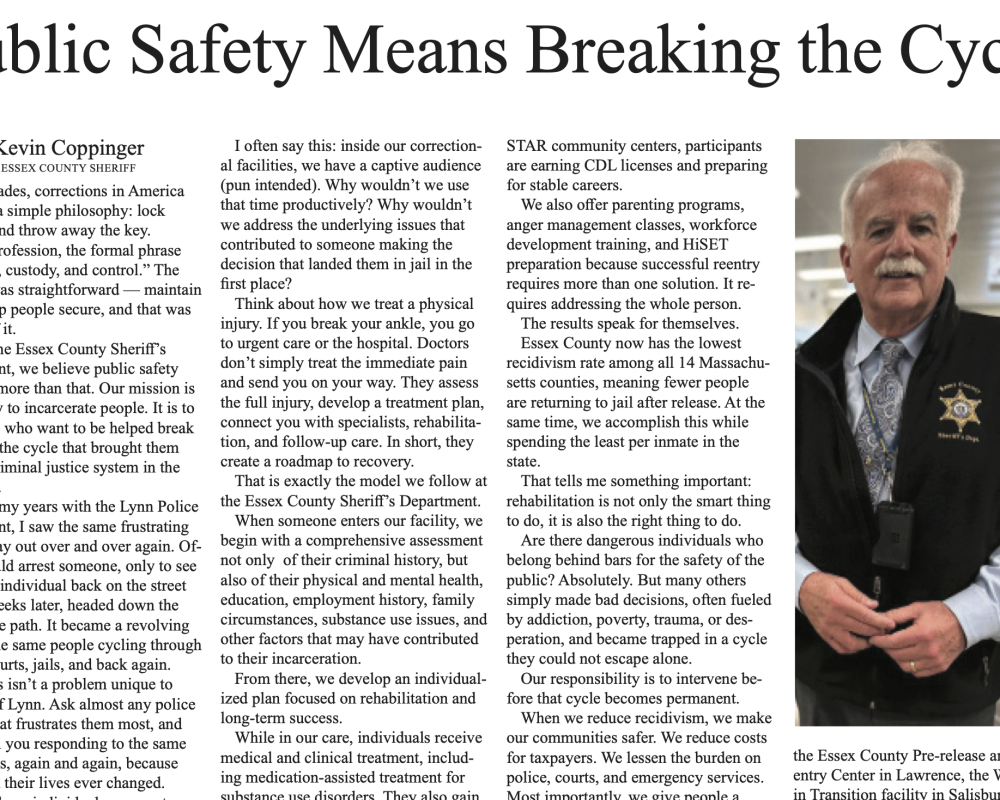
By Sheriff Kevin F. Coppinger
Valley Patriot, June 2026
For decades, corrections in America followed a simple philosophy: lock them up and throw away the key.
In the profession, the formal phrase was “care, custody, and control.” The mission was straightforward — maintain order, keep people secure, and that was the end of it.
But at the Essex County Sheriff’s Department, we believe public safety demands more than that. Our mission is not simply to incarcerate people. It is to help those who want to be helped break free from the cycle that brought them into the criminal justice system in the first place.
During my years with the Lynn Police Department, I saw the same frustrating pattern play out over and over again. Officers would arrest someone, only to see that same individual back on the street days or weeks later, headed down the exact same path. It became a revolving door — the same people cycling through arrests, courts, jails, and back again.
And this isn’t a problem unique to the City of Lynn. Ask almost any police officer what frustrates them most, and they’ll tell you responding to the same individuals, again and again, because nothing in their lives ever changed. Many of those individuals were not hardened criminals. They were people struggling with addiction, mental health challenges, lack of education, unemployment, trauma, or unstable family situations. They didn’t just need punishment. They just needed a pathway forward.
When I became Sheriff in 2017, my goal was to set up a corrections system that uses every tool available to break that cycle.
I often say this: inside our correctional facilities, we have a captive audience (pun intended). Why wouldn’t we use that time productively? Why wouldn’t we address the underlying issues that contributed to someone making the decision that landed them in jail in the first place?
Think about how we treat a physical injury. If you break your ankle, you go to urgent care or the hospital. Doctors don’t simply treat the immediate pain and send you on your way. They assess the full injury, develop a treatment plan, connect you with specialists, rehabilitation, and follow-up care. In short, they create a roadmap to recovery.
That is exactly the model we follow at the Essex County Sheriff’s Department.
When someone enters our facility, we begin with a comprehensive assessment not only of their criminal history, but also of their physical and mental health, education, employment history, family circumstances, substance use issues, and other factors that may have contributed to their incarceration.
From there, we develop an individualized plan focused on rehabilitation and long-term success.
While in our care, individuals receive medical and clinical treatment, including medication-assisted treatment for substance use disorders. They also gain access to hundreds of educational, vocational, and life-skills programs designed to help them succeed when they return to the community.
Those opportunities matter.
Today, incarcerated individuals in Essex County are taking college courses through Merrimack College and Northern Essex Community College. We recently launched a Tier 1 plumbing certification program. Through our STAR community centers, participants are earning CDL licenses and preparing for stable careers.
We also offer parenting programs, anger management classes, workforce development training, and HiSET preparation because successful reentry requires more than one solution. It requires addressing the whole person.
The results speak for themselves.
Essex County now has the lowest recidivism rate among all 14 Massachusetts counties meaning fewer people are returning to jail after release. At the same time, we accomplish this while spending the least per inmate in the state.
That tells me something important: rehabilitation is not only the smart thing to do, it is also the right thing to do.
Are there dangerous individuals who belong behind bars for the safety of the public? Absolutely. But many others simply made bad decisions, often fueled by addiction, poverty, trauma, or desperation, and became trapped in a cycle they could not escape alone.
Our responsibility is to intervene before that cycle becomes permanent.
When we reduce recidivism, we make our communities safer. We reduce costs for taxpayers. We lessen the burden on police, courts, and emergency services. Most importantly, we give people a genuine second chance to build productive lives.
That is what modern corrections should be about. Not just punishment — but prevention, rehabilitation, and public safety that lasts.
Kevin F. Coppinger is the Sheriff of Essex County and a former Lynn Police Chief with more than four decades in law enforcement. He oversees the Middleton Jail and House of Correction, the Essex County Pre-release and Re-entry Center in Lawrence, the Women in Transition facility in Salisbury, and the Supporting Transitions and Re-entry community-based programs in Lynn and Lawrence. The Essex County Sheriff’s Department supports communities across the county through corrections, re-entry, and public safety programs focused on reducing recidivism and improving the quality of life in our neighborhoods.